
Supportive injection therapies
Collagen, peptide and hyaluronic acid preparations
Modern supportive treatment options for selected painful and degenerative musculoskeletal conditions. Targeted injection of preparations may help relieve pain, improve mobility and support the function of affected tissues.
Targeted injection
An individual approach
Outpatient procedure

01
WHAT ARE SUPPORTIVE INJECTION THERAPIES?
Targeted support for the musculoskeletal system
Supportive injection therapies are a group of treatment procedures in which special preparations are injected directly into an affected musculoskeletal area.
Depending on the preparation chosen, they may help relieve pain, improve the mechanical properties of the joint environment or support connective tissue function.
The choice of therapy depends on the diagnosis, health and individual needs of the patient.

Specialist examination
Choice of preparation
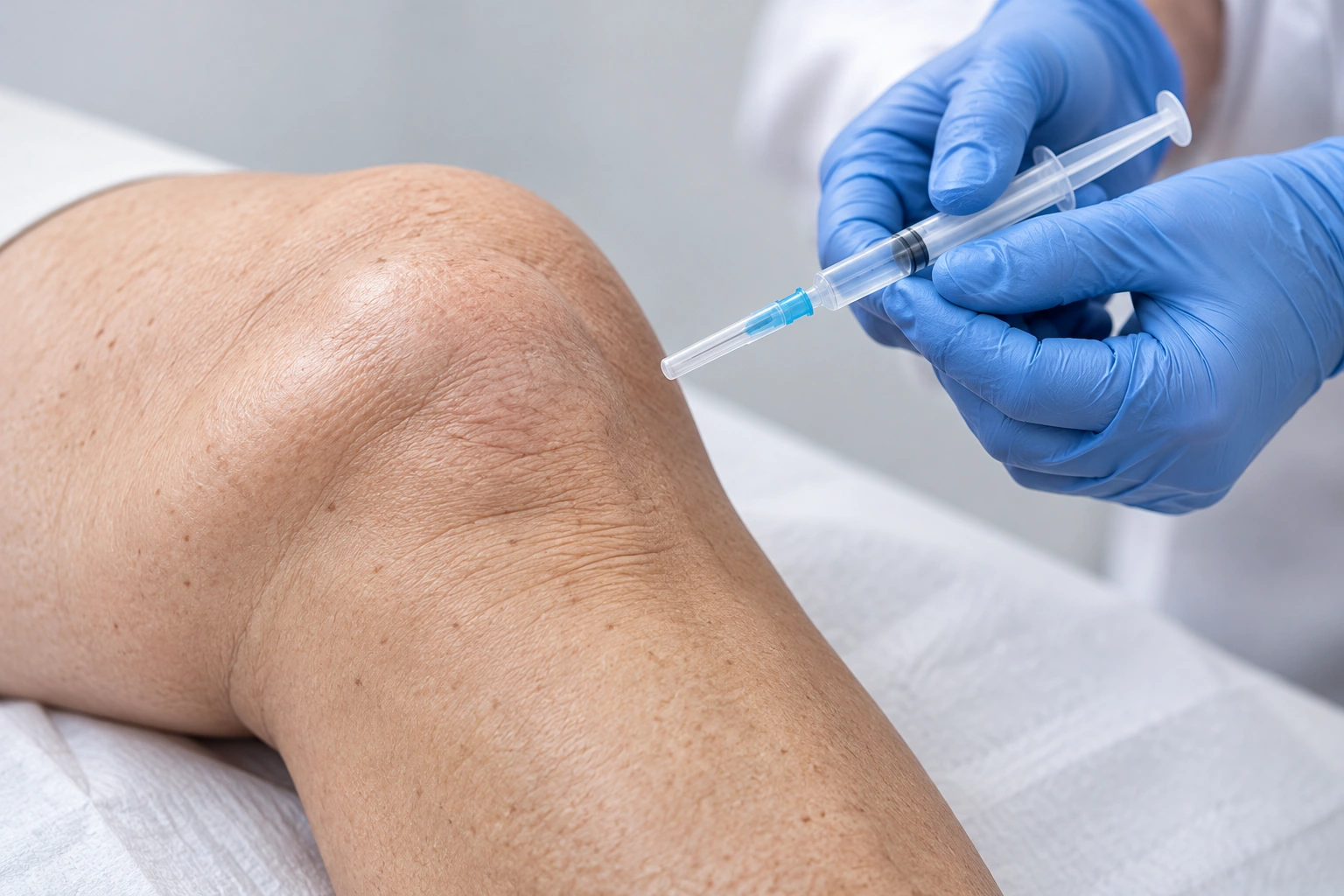
Targeted injection
02
WHAT TREATMENT OPTIONS DO WE OFFER?
Different preparations, an individual approach
Supportive injection therapies include several groups of preparations that differ in composition, mechanism of action and possible uses.

Collagen preparations
Collagen is a natural component of connective tissues, tendons, ligaments and other musculoskeletal structures. Injectable collagen preparations are used in supportive treatment of selected painful musculoskeletal conditions. Their specific use and expected effect depend on the type of preparation and the treated area.

Bioactive peptides
Bioactive peptides are short chains of amino acids that may participate in biological processes in tissues. Selected peptide preparations are used in supportive musculoskeletal treatment.

Hyaluronic acid
Hyaluronic acid is a natural component of synovial fluid, providing lubrication and contributing to proper joint function.
Injectable hyaluronic acid preparations are used mainly for selected degenerative joint conditions. Their aim is to improve the properties of the joint environment and, in some patients, relieve pain and improve mobility.
The choice of preparation always depends on an individual professional assessment.
03
WHO MAY BE SUITABLE FOR TREATMENT?
For selected conditions the musculoskeletal system
Supportive injection therapies may form part of treatment for patients with painful and degenerative conditions of joints and other musculoskeletal structures.
Joints
Selected degenerative changes and painful conditions of large joints, such as the knee or shoulder.
Tendons and tendon attachments
Selected chronic painful conditions associated with overload of tendons, tendon attachments and soft tissues.
Small joints
Painful and degenerative conditions of smaller joints for which targeted local treatment may be appropriate.
Spine
Selected painful conditions of the spine and surrounding structures, if the particular preparation is suitable for the indication.
04
WHAT DOES TREATMENT INVOLVE?
Precise image-guided injection
Supportive injection therapies are performed on an outpatient basis. Depending on the treatment area, a doctor may use ultrasound or X-ray guidance to monitor the needle's position and deliver the preparation precisely.
01
Specialist examination
A doctor assesses your symptoms, diagnosis, health and suitability for the specific treatment.
02
Choice of preparation
An appropriate preparation and method of administration are chosen based on the examination.
03
Targeted injection
The preparation is injected into the designated area under aseptic conditions, with ultrasound or X-ray guidance where necessary.
04
Follow-up care
After the procedure, you will receive recommendations about your regimen, physical activity and any follow-up examination.
05
WHAT CAN YOU EXPECT?
An individual response to treatment
Depending on the preparation and diagnosis, supportive injection therapies aim to relieve pain, improve mobility or support the function of the treated area.
The effect may develop gradually, and its intensity and duration vary between individuals. The outcome depends on the type of preparation, extent of disease, health and other factors.
Supportive injection therapies may be part of a comprehensive treatment plan alongside physiotherapy, rehabilitation and other recommended procedures.
Treatment
An individual response
Follow-up
Return to activity
06
SAFETY AND LIMITATIONS
An emphasis on safety and appropriate indications
Suitability for a particular supportive injection therapy depends on the diagnosis, health, medications and possible contraindications. Different preparations have different safety profiles.
After an injection, temporary pain, tenderness, swelling or bruising may occur at the injection site. More rarely, serious complications may develop, including infection or a reaction to a component of the preparation.
Professional assessment
A doctor assesses the diagnosis, overall health and possible contraindications.
Verified preparations
The choice of preparation follows its documentation, intended use and available evidence.
Precise delivery
Ultrasound or X-ray guidance is used where needed to monitor needle placement.
Possible limitations
Contraindications and risks depend on the preparation and the patient.
Before the procedure, a doctor explains the expected benefit, possible adverse effects and limitations of the chosen treatment.
07
FREQUENTLY ASKED QUESTIONS (FAQ)
Here you will find answers to frequently asked questions about collagen, peptide and hyaluronic acid injection therapies.
01 — How do I know whether I am a suitable candidate for supportive injection therapy?
If you have pain in joints, tendons, tendon attachments or other musculoskeletal structures, supportive injection therapy may be a treatment option.
A specialist doctor determines suitability for the specific preparation based on an initial examination, accurate diagnosis and your health.
02 — What is the difference between peptides, hyaluronic acid, collagen injections and PRP?
Bioactive peptides: Short chains of amino acids that may influence biological processes in tissues. Their specific effects depend on the preparation used.
Hyaluronic acid: Helps improve the lubricating and mechanical properties of the joint environment and may relieve pain in some patients.
Collagen injections: Contain collagen and are used in supportive treatment of selected painful musculoskeletal conditions.
Autologous plasma (PRP): Uses plasma prepared from the patient's own blood with a higher platelet concentration.
The choice of therapy depends on the diagnosis, treatment goal and individual needs of the patient.
03 — Is the injection painful?
The preparation is administered by injection, under ultrasound or X-ray guidance where necessary.
During the procedure, you may feel a brief prick, pressure or mild pain. The intensity depends on the treatment area and individual sensitivity. A doctor may use local anaesthesia if needed.
04 — When can I expect an effect?
The onset of the effect is individual and depends on the preparation, diagnosis and the patient's health.
Some patients may experience improvement within several weeks. The effect may develop gradually, and treatment outcomes are not the same for every patient.
05 — How long may the effect last?
The duration of the effect depends on the preparation used, extent of disease, lifestyle and loading of the treated area.
In some patients, relief may last several months; in others, it may be shorter or insufficient.
A doctor assesses whether to repeat treatment according to the preparation and the outcome achieved.
06 — When is supportive injection therapy unsuitable?
Treatment may be unsuitable, for example, in acute infection or inflammation at the injection site, a known allergy to a component of the preparation, selected autoimmune or oncological conditions, or during pregnancy or breastfeeding if the safety of the particular preparation has not been sufficiently established.
Contraindications differ by type of preparation. A doctor therefore always determines suitability individually.
07 — Do supportive injection therapies have side effects?
Temporary soreness, redness, tenderness, swelling or bruising may occur at the injection site.
These symptoms are often short-lived. More rarely, complications such as infection or an allergic reaction may occur.
Specific risks depend on the preparation and method of administration. Your doctor will explain them before the procedure.
08 — Are collagen, peptide and hyaluronic acid therapies scientifically supported?
The different groups of preparations have different levels of scientific evidence.
Hyaluronic acid has long been used for selected joint conditions, although clinical study results and professional recommendations vary.
For collagen and peptide preparations, the extent of clinical evidence depends on the specific product, its composition and indication.
It is therefore important to select treatment based on available professional knowledge and an individual assessment by a doctor.
Do you have more questions? Get in touch.
We will be happy to provide more information and help you choose the most suitable treatment for your health condition.